
THE 2030 CLIFF — WHY BUILDINGS THAT ARE FINE TODAY MAY STILL NEED A PLAN
Tzvi Karoly
For many building owners, the first Local Law 97 reporting cycle brought welcome news: the building complied with the applicable emissions limit and no penalty was due.
Although the result is encouraging, it may also create a false sense of security. The emissions limits that apply through 2029 were intended to capture the highest-emitting buildings first. Beginning in 2030, those limits become substantially more stringent.
For owners, the relevant question is no longer simply, “Did we comply this year?” It is: “What does our current performance look like under the 2030 limits, and how much time will we need if improvements are required?”
WHY DOES 2030 LOOK SO DIFFERENT?
Each covered building is assigned an annual emissions limit based largely on its size and use, and the allowable emissions per square foot decrease over time. For a general office property type, the limit decreases from 7.58 kgCO₂e/sf during 2024–2029 to 2.69 kgCO₂e/sf during 2030–2034.
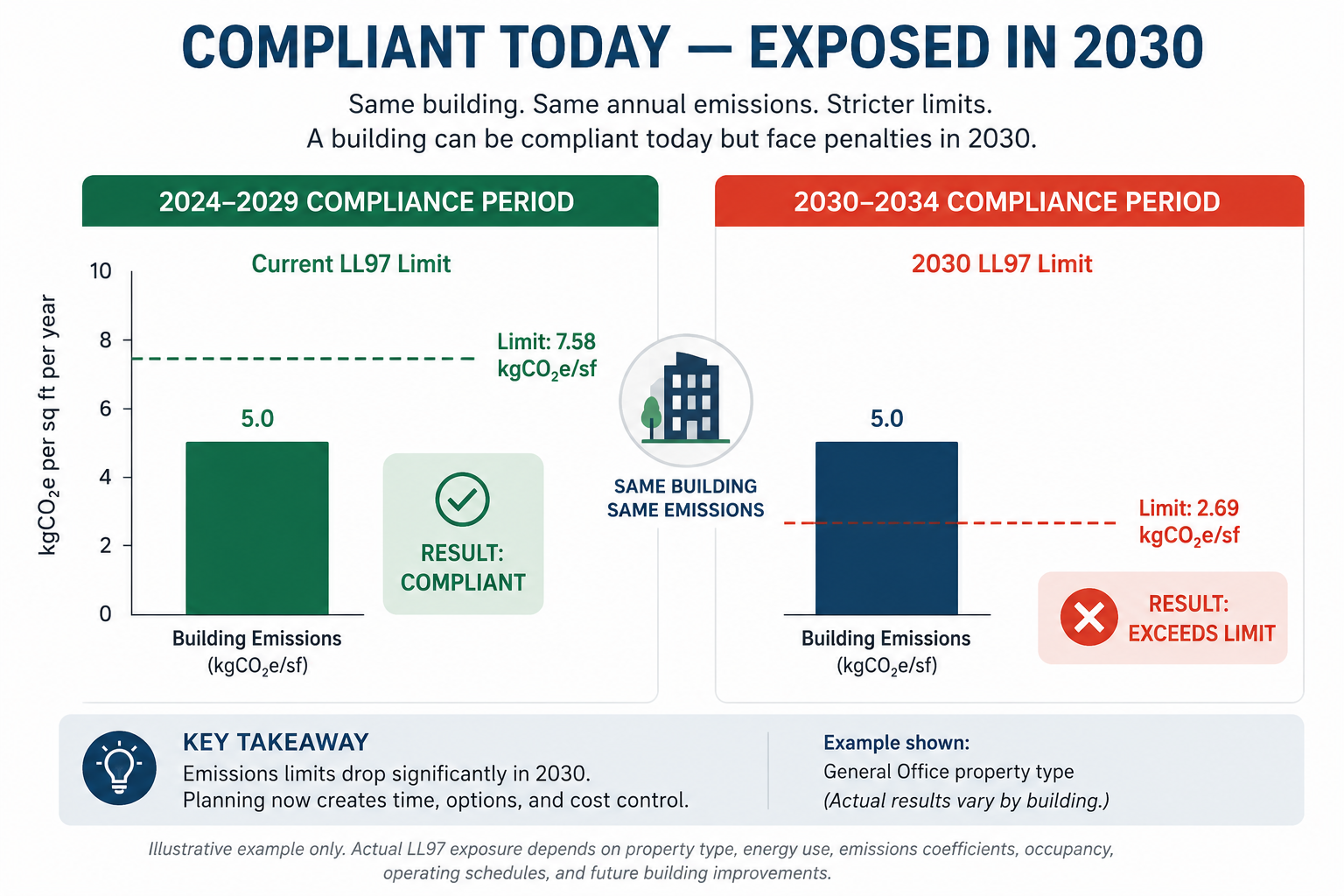
However, the reduction in the emissions limit will not necessarily result in a proportional increase in every building’s penalty exposure.
Future emissions will depend on actual energy use, fuel mix, occupancy, operating conditions, planned improvements, and the emissions coefficients applicable during the next compliance period. In particular, the lower emissions coefficient assigned to electricity beginning in 2030 will reduce the calculated emissions associated with each unit of electricity consumed. As a result, simply comparing today’s emissions limit with the 2030 limit can provide a useful warning, but it is not necessarily a complete forecast.
“NO PENALTY” DOES NOT MEAN “NO EXPOSURE”
A building that reports emissions below its current limit may reasonably conclude that no immediate corrective action is required. But the same result should also be tested against the 2030 limit. A building could remain compliant in 2030; fall close enough to the future limit that modest changes in occupancy or energy use create exposure; or exceed the 2030 limit by a substantial amount.
Those are very different situations. The first may need only continued monitoring. The second may benefit from targeted operational improvements. The third may need a multi-year plan involving audits, energy modeling, design, financing and phased capital work.
The current filing is useful because it provides a reference point from which ownership can begin evaluating future risk.
HOW MUCH TIME DOES A BUILDING REALLY HAVE?
At first glance, 2030 may seem far enough away to defer major decisions. For many projects, however, the available planning window is shorter than it appears.
Operational improvements can sometimes be implemented quickly. Adjusting equipment schedules, correcting controls problems, reducing simultaneous heating and cooling, or improving system sequencing may produce meaningful savings without a major construction project.
Larger measures may take longer to implement. A central heat pump plant, chiller replacement, electrical service upgrade, ventilation heat recovery system or major envelope project may require feasibility analysis, modeling, budgeting, incentive procurement, design, bidding, permitting and installation.
A project that must be operational before 2030 may therefore need to begin several years earlier. Waiting until a penalty appears can also reduce flexibility and make it harder to coordinate work with planned equipment replacement or capital improvement cycles, as well as tenant projects.
START WITH THE GAP, NOT THE SOLUTION
Owners should be cautious about moving directly from a projected 2030 penalty to a predetermined measure. A building that appears exposed in 2030 does not automatically need heat pumps, an energy model or a major capital project.
The first step is to understand the size of the projected gap and the assumptions behind it. How far above the 2030 limit is the building expected to be? Which energy sources appear most significant? Are current utility levels representative? Are planned capital projects already likely to reduce emissions?
Only then should ownership compare potential solutions. Some buildings may need only operational or equipment improvements. Others may need phased electrification, heat recovery, envelope work or major central plant upgrades. Renewable energy credits or other compliance tools may also form part of an interim strategy.
SO, WHAT DO I ACTUALLY NEED TO DO?
A building that avoided a current LL97 penalty should recognize that this is good news, but not necessarily the end of the analysis. Ownership should compare current emissions with the 2030 limit, evaluate any projected gap, and determine whether the building has enough margin to absorb future changes in occupancy and energy use.
Where future exposure appears likely, the next step should be proportionate to the problem. A modest gap may justify a focused utility and operational review. A larger gap may warrant an energy audit, detailed engineering analysis or broader decarbonization plan.
The objective is not to rush into a major project. It is to avoid reaching 2030 without understanding the building’s position or the time required to improve it. The best-positioned buildings will be those that identify the problem early, evaluate the options carefully, and align improvements with normal capital planning.
RDE can help building owners move from filing to strategy by reviewing current and projected LL97 exposure, testing performance against the 2030 limits, and identifying the next practical step — whether that is operational review, energy modeling, incentive planning, or a broader decarbonization roadmap.
In the next article, we will look at the financial consequences of delay and the real cost of doing nothing under Local Law 97.
Tzvi Karoly, PE, CEA, is the Energy Engineering Technical Lead at RDE, where he helps commercial, institutional, and multifamily facilities turn energy data and regulatory requirements into practical energy and decarbonization strategies. He has more than a decade of experience in energy modeling, audits, and sustainability consulting.
Robert Derector Energy & Sustainability (RDE) | Energy Engineering | Modeling | Audit | Strategy