
YOUR LL97 FILING IS COMPLETE.
WHAT SHOULD YOU DO NEXT?
Tzvi Karoly
For several years, much of the discussion around Local Law 97 focused on understanding the law itself: which buildings are covered, how emissions limits are calculated, when penalties begin, and how the rules may affect capital planning.
Those questions still matter. However, for many building owners, the issue has now become more practical. LL97 reporting is no longer a future concern. Buildings are submitting annual reports, and owners are beginning to see what their emissions look like when measured against the law’s limits.
That makes the filing important. It is also important not to overstate what the filing does. An LL97 report can tell an owner whether a building is above or below the applicable emissions limit, how close it is to that limit, and whether a penalty may be due. What it does not necessarily do is explain why the building landed there.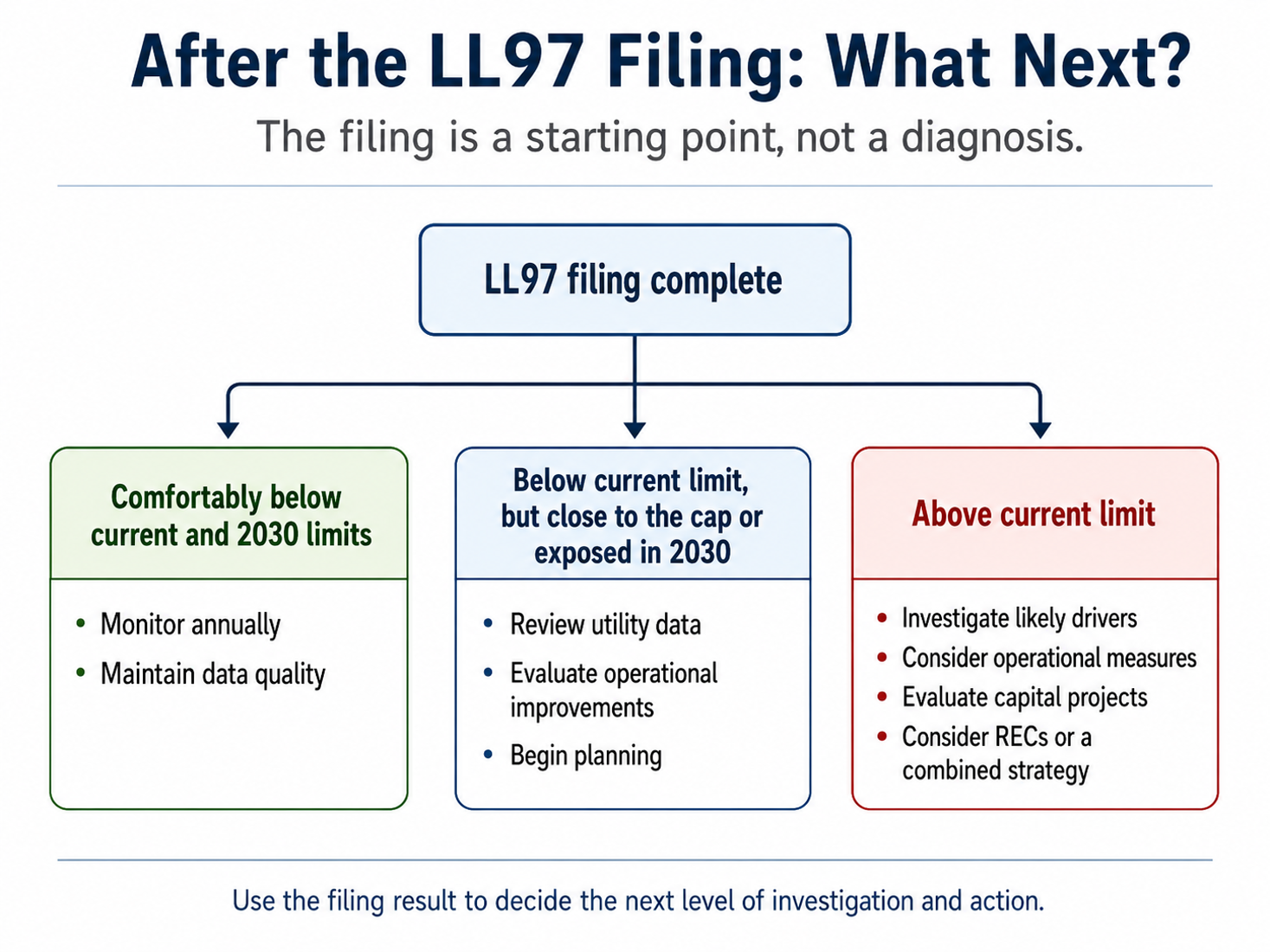
IS THE BUILDING COMPLIANT?
The first question is straightforward: did the building comply with the applicable LL97 limit?
For some buildings, that answer may be enough for the moment. A building that is comfortably below the current limit, with no obvious changes expected, may not need a major study right away. It should still track performance, maintain accurate utility records, and understand how future limits may apply.
For other buildings, the yes-or-no answer is not sufficient. A building that is only slightly below the limit is in a different position from one that is comfortably below it. Similarly, a building that exceeds the limit by a small amount may require a different response than one facing a substantial penalty. The question is not only whether the building passed or failed, but how close it is to the limit.
WHAT SHOULD BE INVESTIGATED NEXT?
This is where owners should be careful. The LL97 filing is not an energy audit, a retro-commissioning study, or an energy model. It may show that a building has a compliance problem, but it does not automatically diagnose the cause.
To move from “the building is over the limit” to “this is what we should do,” ownership needs a more detailed review of energy use and operations. That may include utility bills, tenant meters, base building systems, steam or gas use, operating schedules, after-hours HVAC, ventilation rates, domestic hot water loads, and changes in occupancy.
In some cases, the likely driver may be apparent from a quick utility review. In other cases, especially where ownership is considering a major capital project, the building may need a formal audit, retro-commissioning study, or calibrated energy model.
The filing should raise the next set of questions. A building that is close to the limit, or already over it, should use the filing result as the starting point for understanding what is causing the emissions and which responses are likely to be cost effective.
WHAT HAPPENS UNDER THE 2030 LIMITS?
A second issue is timing. A building that is compliant today may not be compliant under the stricter 2030 limits.
The first compliance period was designed so that many buildings would avoid penalties, while the 2030 limits are significantly more stringent. A clean filing today should not automatically be treated as a clean bill of health. For some buildings, it may simply mean that the current limit is not yet stringent enough to force action.
Owners should therefore compare the current filing result not only against the current limit, but also against the future limit. That comparison helps determine whether the building has time to monitor and make incremental improvements, or whether it needs to begin planning for more substantial measures.
WHAT IS THE RIGHT NEXT STEP?
The right next step depends on what the filing shows.
For a building comfortably below both the current and future limits, the next step may be continued monitoring and good data management. For a building close to the current limit, the owner may want a more detailed utility review and an initial look at operational improvements. For a building compliant today but exposed in 2030, the issue becomes strategic planning. For a building already facing penalties, the question becomes more immediate: whether the best response is operational improvement, targeted capital upgrades, renewable energy credits where applicable, or a combined approach.
What owners should avoid is jumping directly from the filing result to a generic recommendation. “Install heat pumps,” “replace the chiller,” “buy RECs,” or “do an energy model” may each be appropriate in some cases. None of them is the right answer for every building.
SO, WHAT DO I ACTUALLY NEED TO DO?
Owners should treat the LL97 filing as the beginning of a decision-making process, not the end of one. A completed filing may satisfy the annual reporting requirement, but the greater value comes from using that result to make better decisions about operations, budgeting, leasing, incentives, and capital planning.
LL97 compliance will not be solved by paperwork alone. The filing tells the owner where the building stands. The next step is understanding what, if anything, should be done about it.
In the next article, we will look more closely at why buildings that appear compliant today may still be facing a different reality under the 2030 limits.
Tzvi Karoly, PE, CEA, is the Energy Engineering Technical Lead at RDE, where he helps commercial, institutional, and multifamily facilities turn energy data and regulatory requirements into practical energy and decarbonization strategies. He has more than a decade of experience in energy modeling, audits, and sustainability consulting.
Robert Derector Energy & Sustainability (RDE) | Energy Engineering | Modeling | Audit | Strategy