
WHEN DOING NOTHING MAKES SENSE UNDER LL97
Tzvi Karoly
After identifying potential Local Law 97 exposure, owners often ask what project should be approved to reduce or eliminate the penalties. In some buildings, that is the right question. A building with a large projected gap, aging equipment, available infrastructure, and a clear implementation path may need to move quickly.
But immediate construction is not always the best answer. A building owner does not necessarily serve the asset well by rushing into a major project simply because a future penalty appears in a projection. Equipment may still have useful life remaining. Key technologies may still be evolving. The right construction window may depend on tenant turnover, electrical upgrades, or broader building work. The question is not whether waiting is good or bad. The question is whether waiting is part of a deliberate strategy, or simply the absence of one.
WHAT DOES “DOING NOTHING” ACTUALLY MEAN?
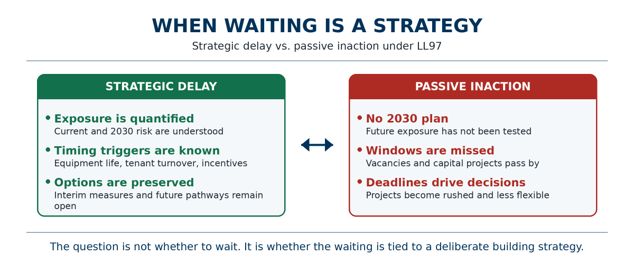
Doing nothing can mean very different things. One owner may be tracking emissions, reviewing utility trends, evaluating equipment life, and preparing to coordinate work with a planned capital project or vacancy window. Another may be assuming that the issue can be dealt with later, without understanding the building’s 2030 exposure or the lead time required to address it.
Those situations are not equivalent. Strategic delay preserves options because ownership understands the building’s position and knows when it should act. Passive inaction reduces options because decisions are deferred until penalties, equipment failures, tenant work, or construction deadlines force a response.
The objective is not to do projects for their own sake. The objective is to identify the right action, at the right time, for the particular building.
WHEN CAN WAITING BE THE RIGHT MOVE?
A delay may make sense when the projected gap is modest or uncertain. If a building is only slightly exposed under a conservative forecast, immediate capital work may be disproportionate to the risk. Continued monitoring, retro-commissioning, controls improvements, and utility review may be a better first step while ownership determines whether the gap is real, growing, or manageable.
Equipment life is another important factor. Replacing a functioning boiler, chiller, air handler, or distribution system too early can waste remaining asset value. A more rational approach may be to plan now so that, when equipment reaches end of useful life, the replacement is not a simple like-for-like decision that locks in a poor long-term position.
Technology can also justify a measured approach. Many NYC buildings still rely on steam, and a full conversion to low-temperature hot water or distributed heat pumps can be disruptive and expensive. For some buildings, it may be reasonable to watch whether high-temperature or steam-producing heat pump technologies become more proven, serviceable, and financeable before committing to a full central-plant conversion. That does not mean ignoring LL97; it means pairing interim measures with a realistic long-term pathway.
Tenant turnover may be the clearest example. In occupied office buildings, meaningful infrastructure upgrades are often not confined to the mechanical room. They may require access through tenant spaces, risers, shafts, ceiling plenums, perimeter zones, and electrical closets. If a block of floors is expected to become vacant, ownership may reasonably coordinate decarbonization work with that turnover rather than attempt disruptive work in occupied space.
That strategy only works if planning starts before the vacancy occurs. Once tenant-improvement drawings are underway, the opportunity to install risers, upgrade electrical distribution, modify perimeter systems, or prepare future heat pump infrastructure may be missed.
WHY SIMILAR BUILDINGS MAY NEED DIFFERENT STRATEGIES
LL97 planning needs to take a holistic look at the building rather than focus only on the penalty calculation. Two buildings may appear similar from the outside: same vintage, similar size, similar use, and similar projected 2030 exposure. The right strategy may still be very different.
One building may have aging equipment, available electrical capacity, and upcoming tenant turnover across several floors. For that building, it may make sense to accelerate design so infrastructure upgrades can be coordinated with capital work and vacancy windows. Another building may have newer equipment, limited electrical capacity, stable long-term tenants, and a modest projected gap. For that building, monitoring, operational improvements, and planning for a later capital cycle may be the better answer.
Similar exposure does not necessarily mean similar strategy. The right answer depends on systems, utility profile, tenant schedule, equipment age, electrical infrastructure, financing, incentives, ownership goals, and tolerance for risk and disruption.
SO, WHAT DO I ACTUALLY NEED TO DO?
The first step is not necessarily to approve a project. It is to understand the building well enough to decide whether to act now, act later, or take interim steps while preserving future options.
For some buildings, the analysis may support waiting. For others, it may show that low-cost operational measures should begin now, while larger improvements are aligned with equipment replacement, tenant turnover, incentive opportunities, or electrical infrastructure planning.
RDE can help owners distinguish strategic delay from passive inaction by reviewing LL97 exposure, utility trends, equipment condition, tenant turnover, infrastructure constraints, incentive opportunities, and capital-planning timelines. The goal is not to recommend projects for their own sake, but to help ownership identify the right action at the right time for the specific building.
In the next article, we will examine renewable energy credits and when they may make sense as part of an LL97 compliance strategy.
Tzvi Karoly, PE, CEA, is the Energy Engineering Technical Lead at RDE, where he helps commercial, institutional, and multifamily facilities turn energy data and regulatory requirements into practical energy and decarbonization strategies. He has more than a decade of experience in energy modeling, audits, and sustainability consulting.
Robert Derector Energy & Sustainability (RDE) | Energy Engineering | Modeling | Audit | Strategy