
PART 4: RENEWABLE ENERGY CREDITS AND LL97 — WHEN DO RECS ACTUALLY MAKE SENSE?
Tzvi Karoly
Renewable Energy Credits (RECs) are becoming a practical Local Law 97 compliance option. NYSERDA’s Tier 4 REC sales now give owners a real purchasing pathway and a price to evaluate. But availability alone is not a reason to buy.
The decision is simpler: Can RECs address this building’s projected penalty, at a reasonable cost, without distracting from improvements the building will still need?
FIRST, WHAT IS A REC?
A REC is a certificate representing the renewable-energy attributes of one megawatt-hour (MWh) of electricity. Under LL97, eligible RECs allow owners to deduct a corresponding amount of electricity-related emissions from their building’s reported total. They do not reduce actual energy consumption or utility bills.
Qualifying RECs must meet NYC’s eligibility requirements, including the connection to New York City’s electrical Zone J. NYSERDA’s Tier 4 REC program is the relevant purchasing pathway for owners considering this option.
CAN RECS ELIMINATE A BUILDING’S LL97 PENALTY?
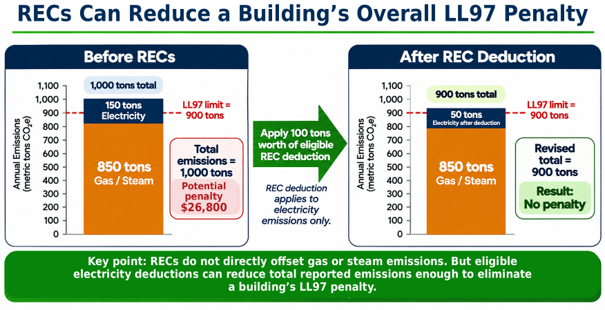
Yes, potentially—even when most of the building’s emissions come from gas or steam. RECs can only be deducted against eligible electricity emissions, but that deduction lowers the building’s total emissions used for LL97 compliance.
Consider a building with 850 tons from gas and steam and 150 tons from electricity. Its total is 1,000 tons against a 900-ton LL97 limit, creating a potential $26,800 penalty. A 100-ton eligible electricity deduction could bring its reported total to 900 tons and eliminate that penalty. Gas and steam emissions remain unchanged.
The critical test is not whether electricity is the largest emissions source. It is whether enough eligible electricity emissions can be deducted to eliminate the penalty, subject to applicable LL97 requirements.
HOW DOES AN OWNER BUY RECS?
NYSERDA offers Tier 4 RECs through voluntary sales and may offer other purchasing arrangements. Owners need to confirm the sale terms, the correct REC vintage, and the required ownership and retirement documentation. For LL97, credits must match the reporting year; a 2027-vintage REC cannot simply be saved for 2030.
ARE RECS CHEAPER THAN LL97 PENALTIES?
NYSERDA’s summer 2026 sale priced 2027-vintage Tier 4 RECs at $35.52 per MWh. LL97 penalties are generally $268 per metric ton over the limit. Because those are different units, the REC price must be converted using the applicable LL97 electricity emissions coefficient.
The comparison below shows why timing matters: at the same assumed $35.52 REC price, the effective cost rises from roughly $123 per ton in 2024–2029 to roughly $245 per ton in 2030–2034, because the electricity emissions coefficient declines. The 2030 calculation is illustrative, not a forecast of future REC prices.
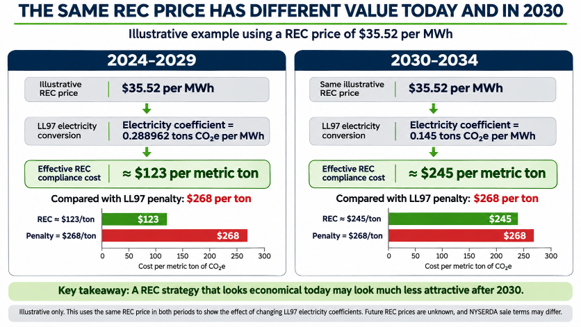
Two important qualifications: the $35.52 price came from a completed sale, not a standing offer, and that sale required a 1,000-REC minimum order ($35,520). Future prices, quantities and terms may differ. Proposed changes to REC rules also create policy risk.
WHEN DO RECS ACTUALLY MAKE SENSE?
RECs deserve serious consideration when a building faces a quantifiable near-term LL97 penalty, has enough eligible electricity emissions for the deduction, and can purchase RECs at a cost meaningfully below the penalty.
They are particularly useful as a bridge when a sensible capital project is already on the horizon—for example, a heating-plant replacement, tenant turnover or electrical upgrade—but cannot be completed before the reporting deadline. RECs can also be rational where the near-term penalty is modest and accelerating an otherwise premature equipment replacement would cost far more.
They are less attractive when eligible electricity deductions would eliminate only a small part of the penalty, minimum purchase quantities exceed the building’s need, REC prices approach the penalty rate, or the building lacks a plan to tackle persistent operational problems. RECs do not fix inefficient controls, excess energy use or aging equipment. Repeated purchases can become expensive, especially under tighter 2030 limits.
The right choice is often RECs combined with building improvements, not one or the other.
SO, WHAT DO I ACTUALLY NEED TO DO?
Start with the numbers: calculate the projected LL97 penalty for the relevant year, determine the eligible electricity emissions available for deduction, and estimate how many RECs would actually help. Then compare the full purchase cost—including minimum quantities and administrative requirements—with the projected penalty and the cost and timing of practical energy improvements.
Finally, test the plan beyond a single filing. Will the strategy still make sense under 2030 limits? Is there an equipment replacement, tenant vacancy or incentive opportunity that changes the best timing? If RECs are used as a bridge, identify what they are bridging toward.
RDE can help owners make that decision by evaluating LL97 exposure and REC eligibility, comparing compliance costs, and coordinating near-term options with operational improvements and phased decarbonization plans. The objective is not simply to avoid the next penalty. It is to choose the right combination of measures for the building and its capital plan.
Tzvi Karoly, PE, CEA, is the Energy Engineering Technical Lead at RDE, where he helps commercial, institutional, and multifamily facilities turn energy data and regulatory requirements into practical energy and decarbonization strategies. He has more than a decade of experience in energy modeling, audits, and sustainability consulting.
Robert Derector Energy & Sustainability (RDE) | Energy Engineering | Modeling | Audit | Strategy